
The Myofascial Slings: Training the Whole System, Not Just the Muscle
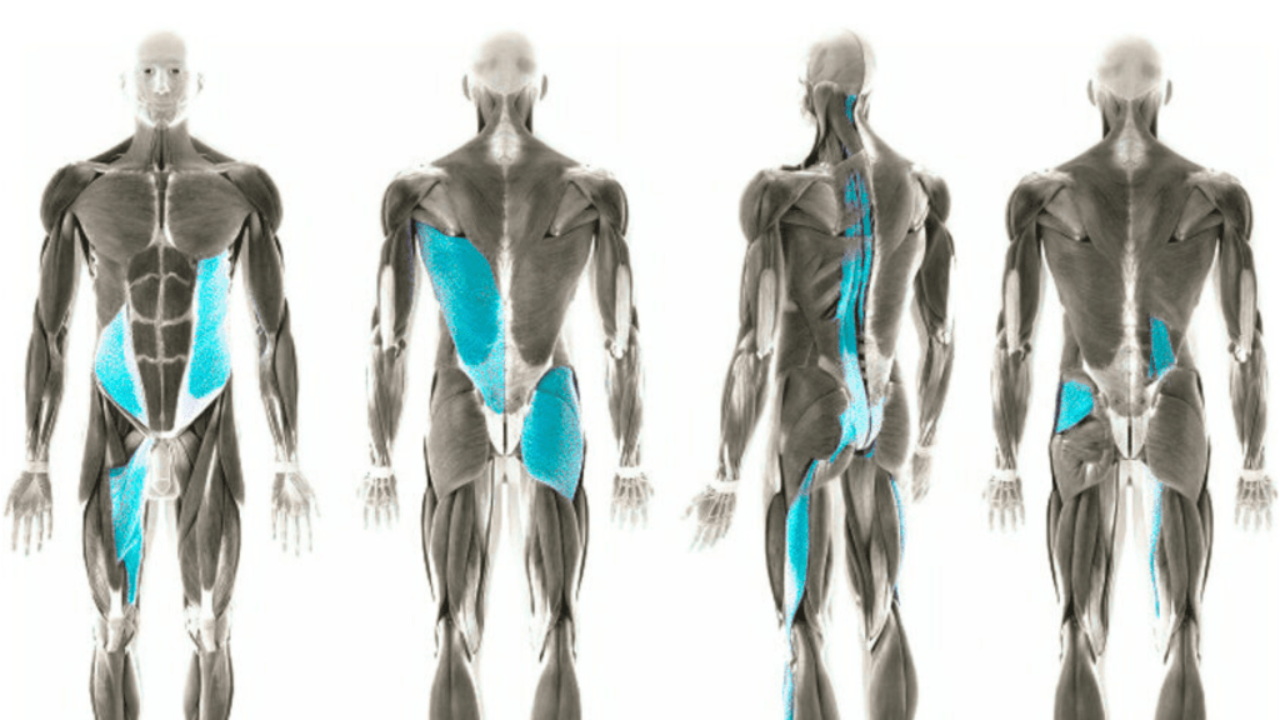
For nearly a century, traditional fitness philosophy has operated under an anatomical framework of isolation. We look at muscle charts on a gym wall and treat the human body like a collection of independent parts. Weight room routines reflect this fragmented worldview: Monday is for chest, Tuesday is for back and Wednesday is for legs. Exercises are designed to isolate a single muscle, such as a bicep curl or a leg extension machine, under the assumption that building a body is a simple game of assembling individual blocks.
However, as we move through 2026, biomechanics and sports medicine have advanced past this mechanical model. Human movement does not happen in isolation. Your brain does not think in terms of individual muscles; it thinks entirely in terms of global movement patterns.
True functional strength, explosive power and injury resilience are governed by Myofascial Slings. These are continuous, interconnected chains of muscle, tendons and sheets of fascial connective tissue that wrap around your entire frame. To build an unbreakable, athletic body, you must stop training individual muscles and start training the entire system.
The Blueprint of Force Transmission
To understand the power of myofascial slings, you have to look at how force travels through the body. Fascia is a tough, elastic web of connective tissue that envelopes every muscle fiber, muscle group, bone and nerve. Far from just a passive casing, fascia acts as a high-speed communication network and a hydraulic force distributor. In fact, research shows that fascia contains up to six times more sensory nerve endings than muscle tissue, making it your body's most sensitive organ for spatial awareness and body positioning.
When a muscle contracts, the force it generates is not contained within that single muscle boundary. Up to 50% of that force leaks laterally into the surrounding fascial sheaths, traveling along predetermined diagonal pathways across your entire body.
These pathways are your myofascial slings. They function like a highly coordinated system of cross-body rubber bands. When you move, one part of the sling stretches to store elastic energy and then snaps back to transfer that energy across your torso to the opposite limb.
If there is a weakness, tightness or "leak" anywhere along one of these slings, your movement efficiency plummets, your performance drops and other joints are forced to overcompensate, creating a direct path to chronic injury.
The Four Major Slings of the Human Machine
While the body contains numerous intricate fascial connections, sports biomechanics prioritizes four primary myofascial slings that coordinate all complex, athletic human movement.
1. The Posterior Oblique Sling (POS)
This sling connects the large gluteus maximus muscle on one side of your body to the massive latissimus dorsi (back) muscle on the opposite side, joined in the middle by the thick diamond of tissue in your lower back known as the thoracolumbar fascia.
The POS is the primary engine behind human locomotion, throwing and athletic rotation. When you take a stride while running, your left glute contracts while your right lat pulls back, tightening the lower back fascia and transferring power diagonally through your core. If your glutes are inactive due to excessive sitting, your lower back fascia cannot tension properly, forcing your lower back muscles to take on structural work they weren't designed to handle, leading to chronic tightness.
2. The Anterior Oblique Sling (AOS)
The front counterpart to the posterior chain, the Anterior Oblique Sling connects the abdominal external and internal obliques on one side to the adductor (inner thigh) muscles of the opposite leg, meeting across the front of the pelvis.
This sling is responsible for acceleration, deceleration and rotational power. It acts as a powerful front brake and accelerator when you change directions on a field, swing a golf club or kick a ball. Weakness in the AOS often presents as chronic groin strains or lower abdominal issues because the body cannot stabilize the front of the pelvis during high-speed movements.
3. The Deep Longitudinal Sling (DLS)
The Deep Longitudinal Sling runs vertically down the back of your body, linking the erector spinae muscles of the spine, the sacrotuberous ligament in the pelvis, the biceps femoris (hamstring) and the peroneus longus muscle in the lower leg.
The DLS is your primary system for managing gravity and vertical forces. It acts as a natural suspension system, absorbing and counteracting the massive downward forces generated when you jump, compress during a heavy squat or land a heavy running stride. When the hamstring or lower leg components are tight and immobile, the shock of movement is transferred directly up into the sacroiliac (SI) joint and lumbar spine, resulting in chronic lower back stiffness.
4. The Lateral Sling (LS)
The Lateral Sling operates on the side of your frame, connecting the gluteus medius and minimus, the tensor fasciae latae (TFL), the IT band and the opposite-side quadratus lumborum (QL) muscle in your lower back.
This sling is your lateral stabilizer. Every time you stand on one leg, walk, climb stairs or carry an object on one side of your body, the Lateral Sling fires to keep your pelvis level and prevent your hip from dropping. A weak Lateral Sling causes your knee to collapse inward during running or squatting, leading to chronic knee pain and poor hip tracking.
The Myth of Isolation: Why Machines Often Fail
The persistent myth of fitness culture is that working out on isolation machines, like a seated chest press or a leg extension machine, translates to functional real-world capacity. In reality, isolation machines artificially stabilize your body. They lock you into a rigid path of motion, allowing a single muscle to fire while completely turning off your stabilization slings.
When you train a muscle in isolation, you build a strong engine inside a weak chassis. The moment you try to apply that isolated strength to a real-world scenario, such as lifting a heavy box, swinging a golf club or moving a piece of furniture, your brain cannot coordinate the force across your fascial slings. The isolated muscle generates power that the surrounding connective tissue chains cannot transfer, resulting in structural failure and injury.
Programming for Global Kinetic Chains
To integrate your training and upgrade your myofascial slings, your programming must move away from body-part splits toward global, multi-joint movement patterns that connect your lower and upper body:
-
Prioritize Rotational Movements: Replace standard static lifts with exercises that force cross-body power transfer. Movements like landmine rotations, cable woodchops and medicine ball rotational throws directly challenge and reinforce the Anterior and Posterior Oblique Slings.
-
Incorporate Asymmetrical Work: Force your Lateral Sling to fire by stepping away from perfectly balanced exercises. Progress a standard two-legged Romanian Deadlift into a single-leg Romanian deadlift, or utilize unilateral suitcase carries, holding a heavy dumbbell in only one hand, to build lateral pelvic stability.
-
Utilize Integrated Full-Body Exercises: Incorporate movements that require your lower and upper body to communicate fluidly along the Deep Longitudinal Sling. The kettlebell swing, the thruster and the clean-and-press force your body to work as a single, cohesive unit.
-
Emphasize Elastic Rebound: Fascia thrives on elastic tissue properties. Incorporating light, controlled plyometrics, such as skipping, medicine ball slams or lateral bounds, trains your slings to efficiently store and release energy like a spring, bypassing sluggish muscle contractions.
The Connected Frame
True physical capability is not a reflection of how individual body parts look in a mirror; it is determined by how seamlessly those parts communicate under tension. Your body is a single, continuous web of integrated tissue.
By shifting your training focus from isolating muscles to strengthening your myofascial slings, you unlock a completely new level of athletic power, movement efficiency and long-term structural resilience. Stop training in parts and start moving as a whole.
Sources
-
Journal of Bodywork and Movement Therapies: "Anatomical evidence for the existence of myofascial slings and their role in force transmission."
-
Clinical Biomechanics: "The role of the posterior oblique sling in pelvic stability and force transfer during human locomotion."
-
International Journal of Sports Physical Therapy: "Functional kinetic chains: Moving beyond muscle isolation paradigms in athletic performance and injury prevention."
Written by: L.R. Moxcey
