
Grip Strength: A Vital Sign for Fitness
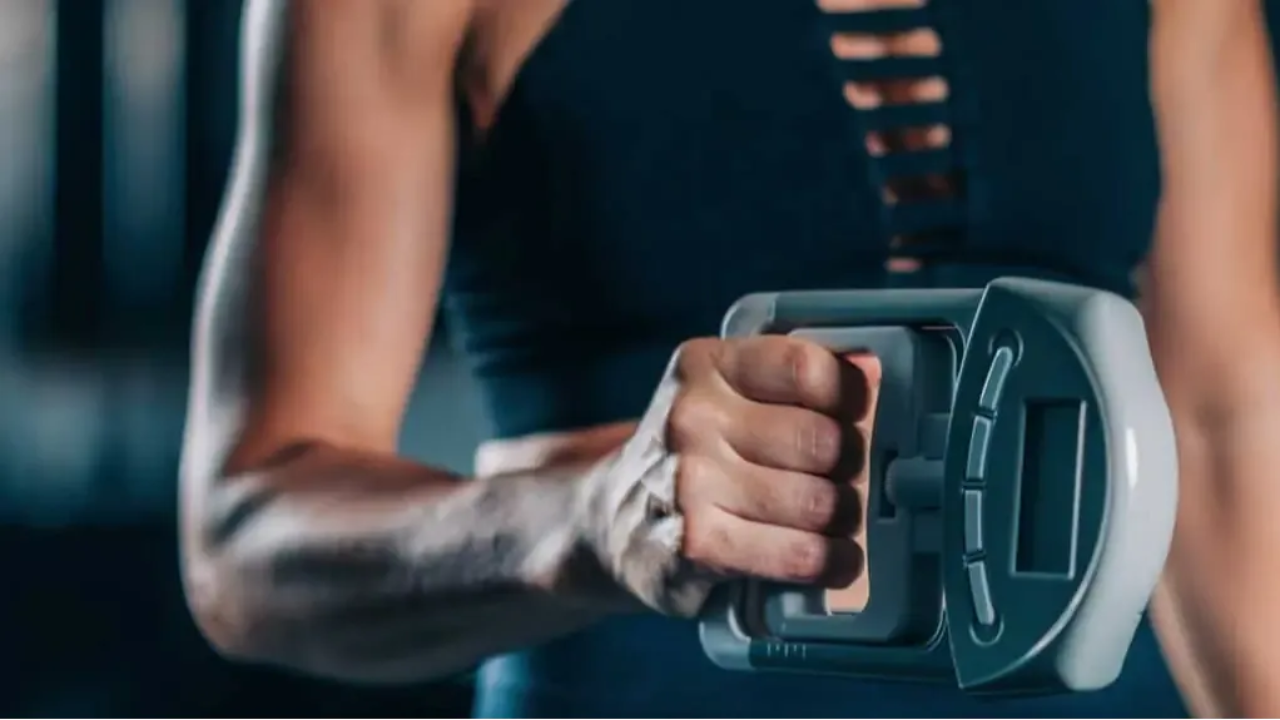
Grip strength is one of those metrics that feels almost too simple to matter. You squeeze something hard, you get a number (or a time), and it’s tempting to file it under “nice to know.” But grip strength keeps showing up in two places that don’t usually agree on much: performance training and large-scale health research.
That overlap is the clue.
Grip strength isn’t important because your forearms secretly run your whole body. It’s important because your hands are the final connection between your body and the outside world. If you can’t create and maintain tension through that connection—whether you’re carrying groceries, holding onto a railing, controlling a suitcase, or training with dumbbells—your strength stays theoretical. You might have an engine, but you don’t have reliable traction.
That’s why grip strength sometimes gets described as a “vital sign.” Not as a diagnosis, and not as a replacement for medical screening or anything your doctor does. Think of it as a quick, low-drama snapshot of how much strength your system can access on demand—and how well you can hold onto it when things get heavy, awkward, or repetitive.
If you’re rebuilding strength (or training consistently but trying to feel more capable), grip strength is an unusually good checkpoint. It helps you measure progress without chasing a risky max lift. It highlights weak links that quietly cap your training. And it can nudge you to respect recovery, because your hands often tell on you before your motivation does.
The real job of your grip isn’t squeezing—it’s connecting
Most people think grip is just “hand strength.” That’s the smallest version of the story. Grip is also a stabilizer, a force-transmitter, and a control system. When you hold something heavy, your body has to organize around it: wrists align, elbows stack, shoulders stay centered, trunk stays braced, and posture holds while you move.
When grip is weak, compensations show up everywhere. Wrists crank back. Shoulders creep toward your ears. Ribs flare. You shift your torso to keep holding on. You might still finish the set, but it’s messy—and that mess has consequences. It can limit performance, irritate tendons, or subtly change movement patterns until your “rebuild” becomes “why is my elbow cranky again?”
Grip is revealing because it’s rarely the only problem, but it’s often the first visible leak in the chain.
This is also why grip strength limits progress in ways people don’t immediately recognize. Your back might have more reps in it, but your fingers quit. Your legs can hinge heavier, but the handle starts slipping. Your conditioning is improving, but you can’t maintain control during carries or hangs. Grip isn’t “extra.” It’s access.
Why researchers keep paying attention to grip strength
In training culture, grip matters because it’s functional. In research, grip matters because it’s measurable, repeatable, and consistently associated with broader outcomes across big populations. That doesn’t mean grip strength is destiny. It means it’s a useful marker—one that tends to travel with general strength, functional capacity, and resilience.
If you’re a trainer, this is gold: a simple metric you can incorporate without fancy equipment, time-consuming testing, or risky max attempts.
If you’re an everyday exerciser, it’s even better: a way to see progress without needing to “prove it” with maximal lifting.
The important middle ground is this: grip strength doesn’t tell you why something is happening. But it can tell you that something is changing—and that’s often the first step toward smarter adjustments.
Grip can also reflect recovery (if you interpret it correctly)
During any rebuild phase, the goal isn’t just to add work. It’s to add work your tissues can adapt to. Enthusiasm tends to ramp faster than connective tissue, which is why people feel great for two weeks… and then suddenly everything feels heavy and their joints start bargaining.
Grip can help keep you honest because it’s sensitive to basics like sleep disruption, stress, under-fueling, dehydration, and accumulated training load. It’s not a perfect fatigue meter, and it shouldn’t become a scoreboard. But if your usual carry feels strangely heavy, or your hands fatigue earlier than normal for the same session, that’s useful information.
One off day is noise. A consistent dip that matches other signals—sluggish warm-ups, tender tendons, poor sleep, unusually high perceived effort—starts to look like a recovery issue worth addressing.
How to measure grip without turning it into a science project
The best grip test is the one you can repeat consistently. Consistency matters more than the device.
If you have access to a hand dynamometer, treat it like a snapshot. Use the same position, squeeze hard for a few seconds, take a short rest, repeat a couple of times per hand, and record the best effort for each side. Retest later under similar conditions.
If you don’t have a dynamometer, you can track grip with a real-life proxy that stays consistent. A suitcase-style hold or carry works well because it’s practical: use the same object, the same load, and the same posture each time. Track your best “clean” time, meaning you stop when posture starts to tilt or you have to compensate.
You don’t need perfect numbers. You need repeatable ones.
What “good grip strength” actually means
People naturally ask, “What number should I hit?” Norms can provide context, but your most useful benchmark is you versus you.
For most adults, “good” grip strength looks like this:
You can carry your life without constantly shifting, dropping, or compensating. You can train pulling and carrying patterns without your hands failing long before the rest of your body is ready. And across the year, your grip stays stable or improves rather than quietly declining.
That last piece matters. Grip strength tends to decrease across adulthood if it isn’t maintained. That doesn’t mean strength is on a timer—it means strength is something you keep on purpose. Training grip doesn’t just make your hands stronger. It protects your access to strength everywhere else.
Grip weakness: training issue or “get it checked” issue?
Normal grip fatigue feels like tired hands. It tends to be symmetrical, predictable, and improved with rest.
Be more cautious when symptoms change in character: numbness, tingling, burning, clumsiness, sudden one-sided weakness, or pain that radiates. Those patterns deserve assessment rather than “push harder.” A rebuild phase is about capability—not forcing the body to tolerate something it’s clearly protesting.
Grip training should make you feel more capable, not more fragile.
The bigger message your hands are sending
Grip strength is humble. It doesn’t come with a flashy dashboard or a hype trend. But it’s one of the cleanest indicators of usable strength—strength that shows up when life demands it and when training gets real.
If you want a simple win that isn’t performative, grip is a strong choice. Establish a baseline, train it as part of your rebuild, and retest later. The number is only part of it. The real change is how steady you feel carrying load, how confident you feel under tension, and how much less your hands “tap out” before the rest of you is ready.
That’s not just stronger hands. That’s stronger ownership of your strength.
Grip strength training plans below:
Before you roll into your next training focus, lock in a simple system you can reuse all year.
-
Use the 3-Week Grip Rebuild Mini-Plan when you’re returning after time off, rebuilding after a busy season, or realizing grip is capping your pulling/carrying work.
-
Use the 10-Minute Grip Finisher Menu when you want a low-effort way to maintain and improve grip strength without adding a separate “grip day.”
3-Week Grip Rebuild Mini-Plan (2 sessions per week)
This mini-plan mirrors smart rebuild principles: ramp gradually, use isometrics as a high-intent option, then add a small dose of controlled eccentrics and balance work to build tissue tolerance.
General rules for all 3 weeks:
Keep wrists neutral. Keep shoulders “down and wide” (avoid shrugging). Stop sets when posture breaks. Aim to finish feeling trained, not wrecked. Discomfort should stay mild and should not flare the next day.
Week 1: capacity + posture control
Session A: Suitcase carry or suitcase hold for three rounds per side, 20–30 seconds each round. Rest as needed so posture stays tall and quiet.
Session B: Farmer carry (two hands) or suitcase carry (one hand) for four total rounds, 20–25 seconds each. Focus on steady breathing and level shoulders.
Week 2: keep carries, add isometrics
Session A: Suitcase carry or hold for three rounds per side, 25–35 seconds. Then towel/strap isometric pull for five efforts of 8 seconds (hard pull, no movement), resting 30–45 seconds between efforts.
Session B: Farmer carry for three rounds of 30–40 seconds. Then crush hold (rolled towel or soft ball) for three rounds of 20 seconds, resting 30–45 seconds.
Week 3: keep carries and isometrics, add controlled eccentrics + balance
Session A: Suitcase carry or hold for three rounds per side, 30–40 seconds. Then towel/strap isometric pull for four efforts of 10 seconds. Then wrist extensor eccentrics (light weight) for two sets of 10 reps per side, lowering slowly for 3–5 seconds each rep.
Session B: Farmer carry for four rounds of 25–35 seconds. Then crush hold for two rounds of 25 seconds. Then finger extension opens (rubber band around fingers) for two sets of 20–25 reps.
If elbows or wrists feel irritated: reduce carry time by about 20–30% for the next session, shorten isometric efforts, and keep eccentrics very light. If irritation persists, return to Week 1 for a week and rebuild more slowly.
10-Minute Grip Finisher Menu (pick one, 2x/week)
These are designed to be appended after a workout or after a longer walk. Choose one option and repeat it for 3–4 weeks before switching. Consistency beats variety here.
Option A: Carry focus (simple, effective, joint-friendly)
For the first 4 minutes, alternate suitcase carries: right side 30 seconds, rest 30 seconds, left side 30 seconds, rest 30 seconds. Repeat once.
For the remaining 6 minutes, do farmer carries: carry 30 seconds, rest 30 seconds, and repeat until the 10 minutes is up.
Goal: finish breathing a little harder, shoulders level, wrists neutral.
Option B: Hold focus (best for people who can’t do long carries)
For the first 4 minutes, do suitcase holds: 20–30 seconds per side, resting 30–40 seconds between sides, and repeat once.
For minutes 4–8, do crush holds: 20 seconds on, 40 seconds off, four times.
For minutes 8–10, do finger extension opens: 25 reps, rest 30 seconds, then 25 reps again.
Goal: high-quality tension without elbow irritation.
Option C: Pull + carry (best for people whose grip fails during rows/pulls)
For the first 6 minutes, do a row variation (band row, cable row, or dumbbell row) in a simple interval: 30 seconds of controlled reps, then 30 seconds rest, repeated six times.
For the last 4 minutes, do farmer carries: 30 seconds on, 30 seconds off, repeated four times.
Goal: grip stays present without turning reps into a sloppy shrug.
Resources
- PURE study (The Lancet):
https://www.thelancet.com/journals/lancet/article/PIIS0140-6736(14)62000-6/abstract
DOI: 10.1016/S0140-6736(14)62000-6 - Umbrella review (Journal of Sport and Health Science via ScienceDirect):
https://www.sciencedirect.com/science/article/pii/S2095254620300752 - International norms paper (full text via PubMed Central):
https://pmc.ncbi.nlm.nih.gov/articles/PMC11863340/ - Isometric exercise in patellar tendinopathy (British Journal of Sports Medicine):
https://bjsm.bmj.com/content/49/19/1277
Written by: L.R. Moxcey
